
UNHCR and EPF work together to support and empower refugee led organisations in Armenia
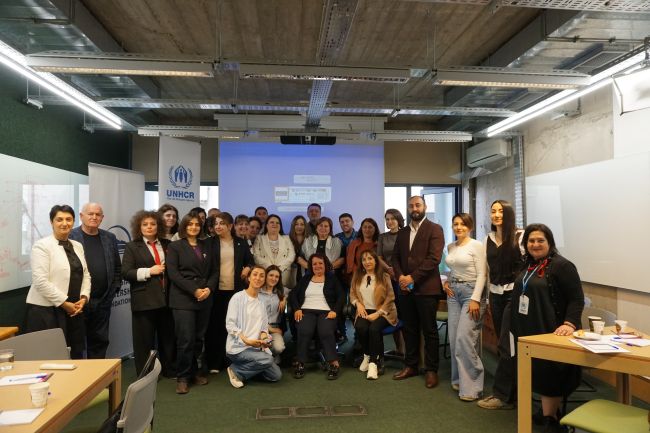
To promote leadership and strengthen the capacity of refugee‑led organisations (RLOs) operating in Armenia, the Eurasia Partnership Foundation (EPF) was entrusted by UNHCR in Armenia to work closely with RLOs representing refugees from Karabakh, as well as from Syria, Ukraine, and Iraq. This collaboration aims to help RLOs better understand and assess refugees’ evolving needs, their rights and obligations, and the national social, legal, education, and employment schemes available to them.
Support for refugee‑led organisations goes beyond counseling and consultations. It includes comprehensive training programmes, development of professional, communication, and organisational skills, and tailoured technical assistance. These efforts are designed to deepen RLOs’ knowledge and practical capacities, as well as their understanding of the host country’s socio‑economic environment and the education, healthcare, and other opportunities available to refugees - in support of their legal, social, economic, and cultural integration in their host country, Armenia.
Following an initial series of consultations with RLOs, two large‑scale workshops were organised with the participation of state and civil society experts, EPF, and UNHCR. The first workshop, held in April 2026, provided the participants with updated information on state support programmes, including access to healthcare, social assistance, documentation and citizenship, as well housing, education, and employment opportunities. The workshop also focused on strengthening RLOs’ communication and advocacy skills, enabling them to effectively present refugee needs and concerns to state and local authorities and to develop meaningful recommendations.
The second workshop, organized last week, served as a networking platform that facilitated open dialogue and interactive Q&A sessions between refugee‑led organisations, state institutions, and civil society actors. Representatives from the Ministry of Labour and Social Affairs and its Unified Social Service, the Ministry of Health, the Migration and Citizenship Service, community social workers, and NGOs actively engaged in the discussions, followed by Q&A sessions. During the workshop, the participants also learnt about the existing support mechanisms, national social schemes and ongoing reforms, community‑based social work, and the practical accessibility of these services for refugees.
Beyond the exchange of expertise, the participants highlighted the importance of regular and structured dialogue between state institutions, host communities, humanitarian actors, and refugee‑led organisations. As both the RLOs and guest speakers expressed, “Greater dialogue and similar coordination platforms will help ensure that state‑supported programmes are well known among refugees and are more meaningful, responsive, and tailored to their evolving needs and priorities.
Regarding refugees’ own contributions to and engagement in the life of the host country, many RLO representatives highlighted the broader role refugee communities can play: “We are not only supporting refugees or seeking humanitarian assistance. We also have significant untapped potential and skills that we are ready to contribute to the societies that host us.”
At the heart of the partnership between UNHCR and EPF is the shared commitment to support refugee‑led organisations both as representatives and supporters of refugee communities, and as active contributors empowered to build more inclusive, resilient, and integrated societies.
As the group expressed at the conclusion of the workshop, “By coming together and cooperating with so many actors, we feel that we are not left alone in facing these challenges and searching for solutions. Working together helps us support our communities, restore our hope and confidence, and feel heard, understood and valued by host communities.”